If a funder has asked for your theory of change and you do not have one, you do not need six months and a facilitator. You need one sentence, and you can write it this week.
In short: a theory of change explains how your work produces the change you claim. Most organizations write the diagram first and the sentence never. Write the sentence first. Furniture Bank’s is on this page, and the full three-page version is available to download and copy.
What it actually is
A theory of change tells the story of how change happens in your organization, from a high level. It names what you do, what comes out of it, and what changes for people as a result.
It also names the assumptions underneath, which is the part most organizations skip and the part most funders are actually reading for.
It is not a strategic plan and not a case for support. It is the logic a funder uses to decide whether your claim is believable.
Start with one sentence, not a diagram
Kevin L. Brown of Mighty Ally publishes a formula that compresses an entire model into a single line. Six pieces, in order:
We work (where) to help (who) (what) (how), in order to (when), because (why).
It is long and it is clunky. It is not a tagline and it is not an elevator pitch. Its job is to force your team to agree on six things before anyone opens a design tool.
Here is Furniture Bank’s, unedited:
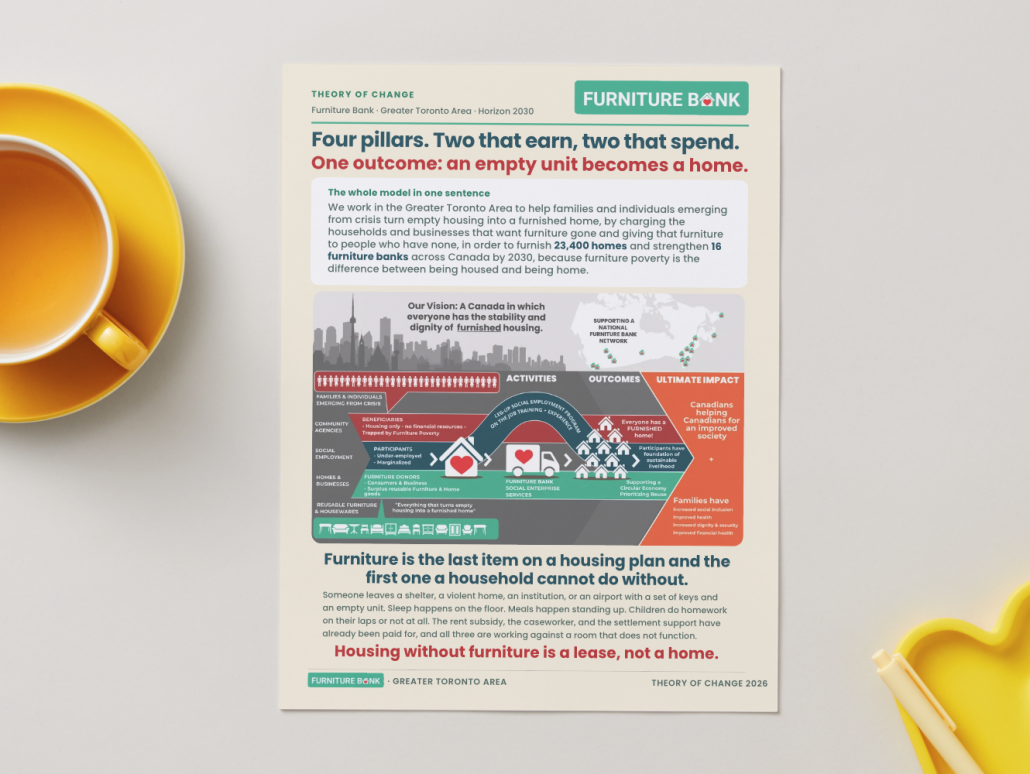
We work in the Greater Toronto Area to help families and individuals emerging from crisis turn empty housing into a furnished home, by charging the households and businesses that want furniture gone and giving that furniture to people who have none, in order to furnish 23,400 homes and strengthen 16 furniture banks across Canada by 2030, because furniture poverty is the difference between being housed and being home.
The uncomfortable piece is the how. Charging donors to take furniture away is the part boards argue about and the part that pays for everything else. If your one-sentence version leaves out how the money works, you have written a mission statement instead.
What it cost us, and what we got wrong
Furniture Bank built its first theory of change in 2013 with Innoweave, through the Impact and Strategic Clarity programme. Six months of facilitating and coaching, with a working team of three staff and three board members.
Version one was finished in the first quarter of 2014. Version two replaced it in the second quarter of 2014. Version three came in 2015, version four in 2017, and the current detailed model in 2025.
The first version lasted three months. That is the most useful thing we can tell you about the process.
Two things we got wrong are worth copying around rather than repeating.
Landfill diversion was not in our original theory of change. It was added at version three in 2016. The environmental claim that now appears in every corporate conversation we have was absent from our own first account of what we do, because at the time we thought of it as a side effect rather than an outcome.
The second is the horizon. Our first intended impact statement committed to numbers “by 2019.” That date has passed. A theory of change with a target in it expires, and if you do not set a review date, the document quietly becomes wrong while still sitting on your website.
The five mistakes we see most often
- Writing it for the funder instead of for the team. Of the seven uses Furniture Bank listed for its own model, five were internal: staff clarity, board agreement, evaluation design, implementation transparency, and communication consistency.
- Leaving out the activity you are best known for, because it does not feel charitable enough.
- Setting a target with no expiry date and no review cycle.
- Drawing arrows instead of making claims. An arrow between two boxes is an assumption. Write it as a sentence someone could disagree with.
- Putting outputs in the outcomes column. Tonnes diverted is a count of what you did. It is not a change in anyone’s condition.
Who this is wrong for
If you are a one or two person operation and no funder has asked, the one-sentence version is enough. Build the diagram when someone needs it, not before.
If you are entirely grant funded, the spine of Furniture Bank’s model will not fit you. Ours splits four pillars into two that earn and two that spend, because our removal service is a revenue line rather than a logistics cost. An organization without earned revenue needs a different structure, and copying ours will misrepresent how your money actually moves.
And a theory of change will not fix a programme that does not work. It will make the gap easier to see, which is useful and is not the same thing.
Download Furniture Bank’s, and take what fits
The three-page funder version is available here as a PDF.
It contains the one-sentence model, the intended impact statement with its horizon, the four pillars, a legend that keys the written document to the visual diagram, the five assumptions the whole thing rests on, and a section headed “where this stops” that names what Furniture Bank does not do and where the evidence is thin.
That last section is the one worth copying. It states plainly that furnishing a home is well supported in published research as improving comfort, wellbeing, and attachment to place, and that the link to sustained tenancies and reduced evictions is plausible, widely assumed, and not proven in Canada.
Funders trust an organization that marks its own weak evidence more than one that marks none.
Your next step
Write the one sentence. Six pieces, one line, no diagram. Take it to your next board or staff meeting and see whether anyone in the room disagrees with the how or the why.
If they do, you have found the real work, and you have found it in an afternoon instead of six months.