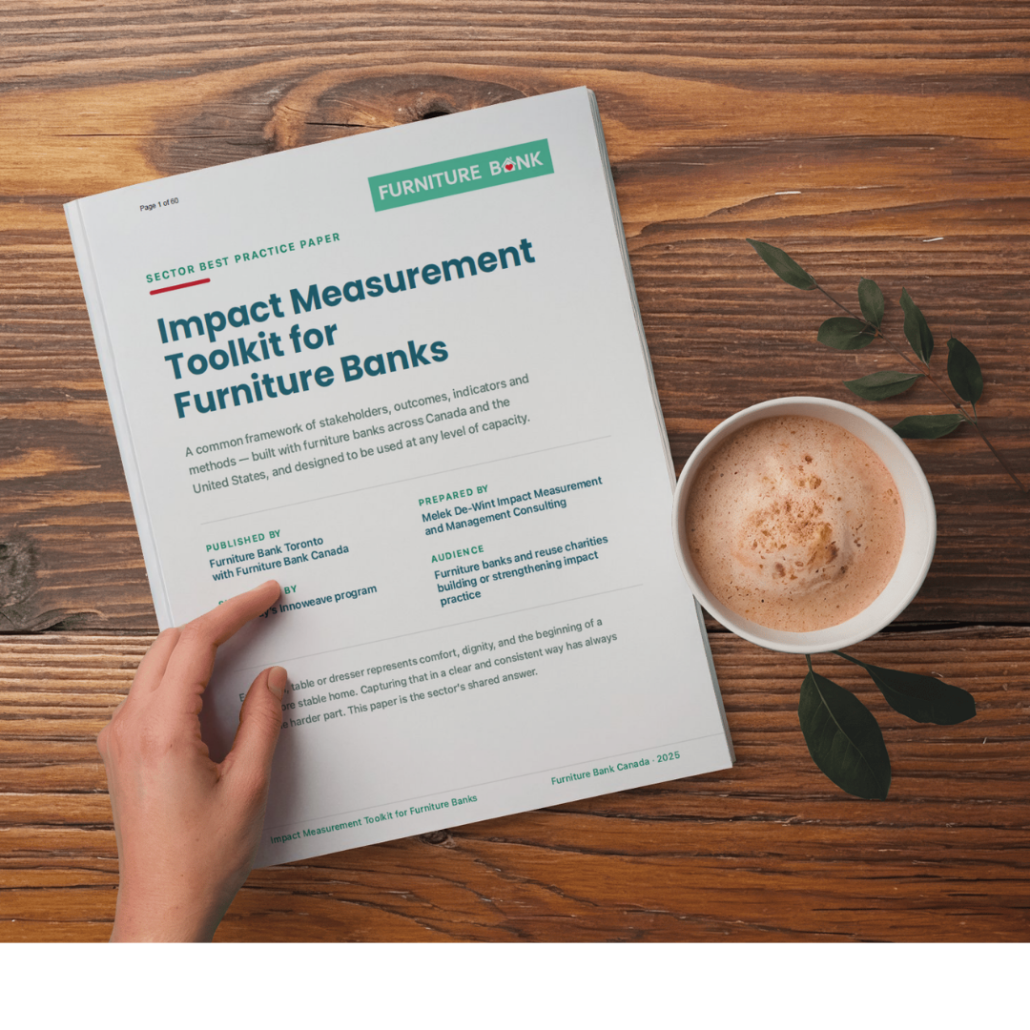
TLDR. The Impact Measurement Toolkit for Furniture Banks is out — 60 pages, free, built with thirteen furniture banks across Canada and the United States. It gives the sector one shared set of stakeholders, outcomes and indicators, three sample surveys you can copy, and a 90-day start plan for a bank that measures nothing today. The forecasting tool it describes is now live: run your own numbers through the SROI estimator and see what your year is worth before you commit to anything.
Why this exists
Every furniture bank gets the same question from funders, and almost every one of us answers it differently. How many families? Compared to what? Over what period? Measured how? The result is a sector that delivers a genuinely comparable service and reports it in a dozen incompatible dialects — which means no one can add our numbers up, and every bank negotiates its credibility from scratch.
In May 2025 we ran a series of working sessions with furniture banks across North America to try to fix that. Not to invent a framework and hand it down, but to ask operators what they already count, what they find easy, what they find impossible, and what they would actually report on if someone gave them the words. This Toolkit is what came out of those sessions.
Thirteen organisations contributed: A Wider Circle, Caritas, Community Warehouse, DIG Furniture Bank, Furniture Friends, Furniture Bank Metro Atlanta, Home Again Furniture Bank, Home Sweet Home, HomeStart Foundation, Make It Home, Matthew House Ottawa and Welcome Collective, alongside Furniture Bank in Toronto. It was prepared by Melek De-Wint Impact Measurement and Management Consulting, published by Furniture Bank Toronto with Furniture Bank Canada, and supported by MakeWay‘s Innoweave program.
What is actually in it
Ten sections, and you are not expected to read them in order. The structure assumes you will land on the part that matches the problem in front of you today.
- Stakeholders and outcomes. Four groups — clients, furniture donors, social service agencies, and the environment — with the outcomes each one actually experiences, drawn from what operators reported rather than from theory.
- The measurement framework. Six core output indicators, plus the outcome indicators underneath them, phrased so you can lift them straight into a survey.
- Data collection and ethics. Consent, voluntary participation, protecting identity, and what PIPEDA and CCPA actually require of a small charity collecting client data.
- Data analysis. Including a section on where AI genuinely helps and where it does not.
- The SROI tool. What it does, what it needs from you, and what it will not do.
- Communicating results. Formats by audience, with the difference between what a Board needs and what a corporate donor needs spelled out.
- Appendices. Three complete sample surveys — client, furniture donor, social service agency — plus an impact report checklist.
- Quick start. The first 90 days, in eight steps, for a bank starting from nothing.
The three things worth knowing before you download it
1. No stage is a prerequisite for credible reporting
The Toolkit sorts practice into three stages — starting out, growing, established — and then says something that matters more than the model itself: no stage is a prerequisite for reporting credible impact. A bank counting deliveries in a spreadsheet and asking five clients how they are doing at ninety days is producing real evidence. It is not a lesser version of a proper evaluation. It is the proper evaluation, at your size.
If you are trying to work out where to begin, we wrote a companion piece on exactly that: what a small furniture bank should measure first.
2. You do not need SROI to measure your impact
That sentence is in the Toolkit, in a callout, deliberately. SROI is one method for expressing value in monetary terms. It is not the definition of impact measurement, and treating it that way has kept a lot of small banks from starting at all because they assumed the entry price was a consultant and a year of data.
It is not. Outputs, a handful of outcome percentages and three stories a quarter is a defensible impact practice. SROI comes later, if it comes at all. If a funder has specifically asked you for a ratio, the honest answer about what a forecast can and cannot carry is here: is a forecast SROI good enough for my funder?
3. Do not overclaim
Of the eight SROI principles the Toolkit works from, this is the one that will cost you a relationship if you get it wrong. Deadweight — would the change have happened anyway? Attribution — who else contributed? Displacement, drop-off. Every one of those is a subtraction from your headline number, and the discipline of applying them is what separates a figure a funder can defend internally from a figure they quietly stop citing.
It applies to environmental claims most sharply, because tonnage is the number the sector is loosest with. The Toolkit measures the environment in both directions: emissions avoided through reuse, and emissions created by your own pickups and deliveries. If you have never netted those off, how to prove your diversion numbers are real covers the evidence chain.
The estimator is live
The Toolkit describes an SROI forecasting tool and says it will be available through Furniture Banking Support Services. It is now up, and you can use it today.
It is a forecasting tool, not an evaluation. You enter a small set of figures you almost certainly already have — operating expenses for the year, the value of charitable receipts issued to furniture donors, volunteer hours and the rate you would have paid for that labour, clients and households served, individual donors, referrals from agencies, referrals from agencies with accommodation facilities, tonnes of CO2e avoided, and kilometres or miles driven for pickups and deliveries. If you do not track emissions, it will estimate them from your item counts.
What comes back is a forecast SROI ratio, a total social value figure, your total input, the net value, and a breakdown of value by stakeholder group — so you can see whether your value is concentrated in clients, in donors, in agency capacity or in the environment. You can also pull a one-page branded PDF of the result.
The valuations underneath it come from Furniture Bank Toronto’s annual SROI model, updated every year, applied consistently across every organisation using the tool. That consistency is the point: it is what makes the outputs roughly comparable across the network, and it is also the reason the tool cannot be tuned to flatter your particular year.
Two cautions before you send the result to anyone. The estimate is only as good as the inputs, and the definitions have to be applied the same way by everyone for a comparison to mean anything — which is the whole subject of can I compare my SROI to another furniture bank’s?
Where the SDGs fit
The Toolkit maps the sector’s common outcomes to three Sustainable Development Goals — 1 (No Poverty), 11 (Sustainable Cities and Communities) and 12 (Responsible Consumption and Production) — and to the E, S and G of standard ESG reporting. Those three are the set that applies to every furniture bank regardless of program mix. Banks running a social employment program have a fourth claim available to them in SDG 8, which most leave unmade; we covered the full argument in which SDGs should a furniture bank claim?
Start with ninety days, not with a system
The last section of the Toolkit is the one to read first if you are starting cold. Eight steps, one quarter, no SROI, no new software, no new staff: name your stakeholder groups and pick two to report on. Pull last year’s delivery numbers as a baseline. Choose five client outcomes, not fifteen — the ones your drivers already hear at the door. Build one short survey in Google Forms. Write your consent script before you collect anything. Put the 90-day follow-up in the calendar as a recurring task rather than a project. Collect three stories a quarter, with consent. Then publish once, and change one thing in the service because of what you learned.
That last step is the one that closes the loop, and it is the one most often skipped. Measurement that never changes an operation is just reporting.
If and when you do want the full system — the survey infrastructure, the analysis, the annual cycle — what it takes to build a full impact measurement system sets out the real cost in time and money before you commit.
Get the Toolkit
The Impact Measurement Toolkit for Furniture Banks is free to download and free to use. Copy the surveys. Adapt the indicators. Put your own name on the consent script. It was built to be used, not cited.
Download the Impact Measurement Toolkit for Furniture Banks (PDF, 60 pages) →
If you want help applying it — training on the estimator, support interpreting results, or coaching on strengthening your data collection — that comes through Furniture Banking Support Services. Get in touch and we will point you at the right starting place for your stage.
Suggested citation: Furniture Bank Toronto. (2025). Impact Measurement Toolkit for Furniture Banks.