TLDR. The impact measurement section of this site is now complete. A free 60-page Toolkit built with thirteen furniture banks. A free SROI Forecast Calculator that runs your year against Furniture Bank Toronto’s full SROI model in about ten minutes. Eight articles answering the questions funders actually ask. All of it built on the international SROI standard, all of it open, none of it requiring a consultant to start.
What is new
Between May and September 2026 we published a complete impact measurement resource set for furniture banks across Canada and the United States. Three things sit at its centre.
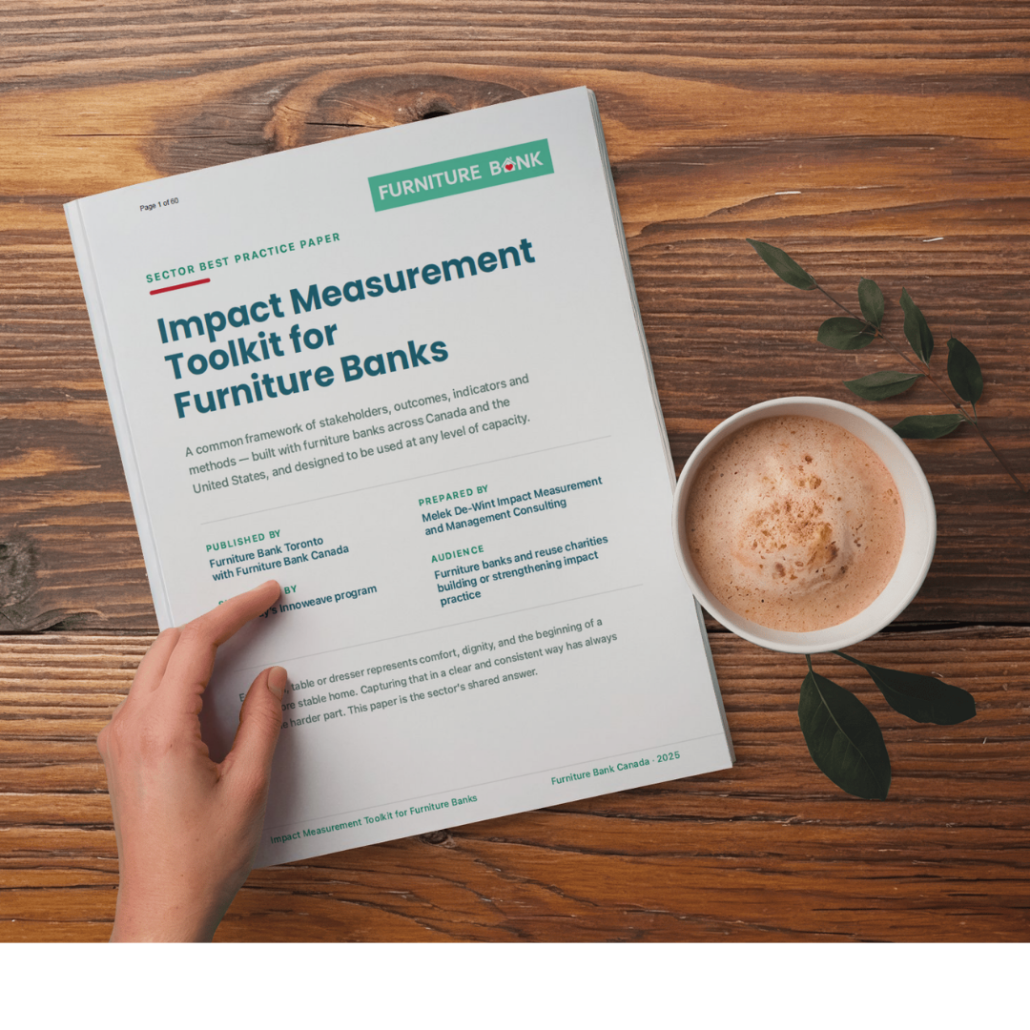
The Impact Measurement Toolkit for Furniture Banks. Sixty pages, free to download and free to copy. Built out of working sessions with thirteen organisations — A Wider Circle, Caritas, Community Warehouse, DIG Furniture Bank, Furniture Friends, Furniture Bank Metro Atlanta, Home Again Furniture Bank, Home Sweet Home, HomeStart Foundation, Make It Home, Matthew House Ottawa and Welcome Collective, alongside Furniture Bank in Toronto. Prepared by Melek De-Wint Impact Measurement and Management Consulting, published by Furniture Bank Toronto with Furniture Bank Canada, supported by MakeWay‘s Innoweave program. Four stakeholder groups with their outcomes, six core output indicators, three complete sample surveys, a data ethics section covering PIPEDA and CCPA, and a 90-day start plan.
The SROI Forecast Calculator. Live, free, open to any furniture bank in Canada or the United States, in CAD or USD.
Eight articles. Each answers one question, names its sources, and marks what is not yet known.
Why we build on SROI
Social Return on Investment is not a niche technique or a Furniture Bank invention. It is an international standard with a documented lineage, a standards body, an assurance process and a global practitioner base.
The method was codified in A Guide to Social Return on Investment, published in 2009 with the backing of the UK Cabinet Office’s Office of the Third Sector and the Scottish Government, delivered by a consortium that included the SROI Network, the New Economics Foundation, Charities Evaluation Services, the National Council for Voluntary Organisations and New Philanthropy Capital. It was revised in 2012, issued in a US edition, and translated for use in other currencies and jurisdictions.
It is maintained today by Social Value International, a global standard setter whose community spans more than sixty countries through roughly 26 national and regional networks and some 4,000 practitioners, and which works alongside institutions including the UNDP, the OECD and the Impact Management Platform. The method runs on eight Principles of Social Value — involve stakeholders, understand what changes, value the things that matter, only include what is material, do not over-claim, be transparent, verify the result, be responsive — applied through six formal stages.
It is also the most used valuation method in the peer literature. When the UK Department for Culture, Media and Sport reviewed 56 valuation studies of civil society in July 2025, 23 of them used SROI, more than any other single method.
This matters commercially, not just academically. Furniture Bank has measured this way deliberately since 2013, and the relationships that followed — with corporate partners, with government, with major donors — were built in large part on being able to answer the value question in a language those institutions already use. An ESG team reporting against a recognised framework can take a figure produced under that framework straight into its own reporting. A government funder reviewing an SROI analysis is reviewing something its own departments commission. That is the practical return on measuring properly, and it is available to any furniture bank willing to count consistently.
What the calculator actually does
The calculator is a web version of Furniture Bank Toronto’s own SROI workbook. It is a forecast tool: it applies Toronto’s measured outcome pattern and valuation set to your counts. It is not an evaluative study of your organisation, and the model says so.
What you enter
Organisational details first — organisation name, contact, the country and province or state you serve, your currency of analysis, whether you deliver services beyond furniture and household goods, and the twelve-month analysis period.
Then costs. At least one is required.
- Operating expenses for the analysis year, including staff costs, for the furniture and household goods service only
- Total value of charitable receipts issued to individual furniture donors, split at the $200 per donor per year threshold
- Total volunteer hours on the furniture service
- The gross hourly rate you would have paid for that work. For Furniture Bank in Toronto in 2025, that rate was CAD $22
Then your stakeholder counts. At least one group is required, and you can leave any group blank.
- Clients. Total individuals served, and how many of those individuals were household members living as a family
- Furniture donors. Number of individual or household donors, excluding business donations
- Social service agencies. Households referred by agencies, and separately, households referred by agencies that operate accommodation facilities
- Environment. Tonnes of CO2e avoided through reuse, and tonnes created by your own pickups and deliveries. If you do not hold an emissions figure, a built-in converter will calculate it from diesel or gasoline usage in litres or US gallons
What it calculates
Twenty-four outcomes across the four groups, each one valued separately rather than rolled into a single assumption.
- Thirteen client outcomes: worrying less about money, feeling safer at home, increased freedom and independence, a greater sense of dignity and control, feeling less unhappy or depressed, increased self-esteem, eating better, sleeping better, improved physical comfort, being able to invite family and friends over, feeling less isolated, increased confidence to form relationships, and feeling more accepted in the community.
- Three family outcomes: quality time together, stabilised daily routines, improved family relationships.
- Two donor outcomes: giving back to others, and giving back to the planet.
- Four agency outcomes: reduced time and resources spent procuring furniture, improved capacity to support clients in other areas, increased housing stability, and — for agencies with accommodation — reduced time for clients to move on into housing.
- Two environmental outcomes: emissions avoided through reuse, and emissions created by your fleet, which is subtracted.
Each outcome carries its own financial proxy, quantity, duration, deadweight, displacement, attribution and drop-off, with a 2.25% discount rate applied to future years. These are the adjustments the standard requires and they all reduce the headline figure. Client outcomes in Toronto’s model persist between roughly two and three years; deadweight sits between 17% and 33% and attribution between 22% and 40%, taken from Toronto’s own stakeholder surveys rather than assumed.
Your donation inputs are adjusted too. Charitable receipt values are discounted for the tax credit the donor receives, then discounted again to reflect the share of donors who report the furniture would have been discarded outright — 23.3% in the 2025 donor survey. Only the genuinely foregone value is counted.
The proxy set is externally sourced and inflation-adjusted, not invented. Values are drawn from HACT’s UK Social Value Bank, the wellbeing approach used for the Birmingham 2022 Commonwealth Games evaluation derived from the What Works Centre for Wellbeing and HM Treasury’s Wellbeing Guidance for Appraisal, published charity retail SROI work, and Furniture Bank’s own studies. All are converted using OECD purchasing power parities and brought to 2025 values using US Bureau of Labor Statistics and Bank of Canada inflation figures, in both CAD and USD. The workbook states its own lineage plainly: it is consistent with international standards of practice for SROI and adapted from the SROI Network’s A Guide to Social Return on Investment and its training materials.
What you get back
A results summary written in plain sentences with your organisation, region and analysis period filled in, plus the numbers behind it: total present value across the analysis year and the two following years, present value for the analysis year alone, your total inputs broken into operating expenses, donation value and volunteer value, net present value, your forecast ratio, and the split of social value across the four stakeholder groups in both dollars and percentages. You can export a one-page branded PDF.
Running the model’s own sample organisation — $2.5m of operating expenses, $1.55m in donation receipts, 4,000 volunteer hours, 3,000 individual clients, 5,000 donors, 2,000 agency referrals, 2,500 tonnes of CO2e avoided against 180 created — returns $33.5m of value in the analysis year against $3.32m of inputs, a ratio of 10.11:1, with 58.8% of the value sitting with clients, 25.0% with furniture donors, 15.9% with agencies and 0.3% with the environment. Those inputs are invented for illustration. The shape of the output is what to look at: the stakeholder split usually tells you more about your organisation than the ratio does.
Run your numbers through the SROI Forecast Calculator →
The full measurement library
- Introducing the Impact Measurement Toolkit for Furniture Banks — what is in the 60 pages and how to use it
- What should a small furniture bank measure first? — six counts, in order, and why your written definitions matter more than the numbers
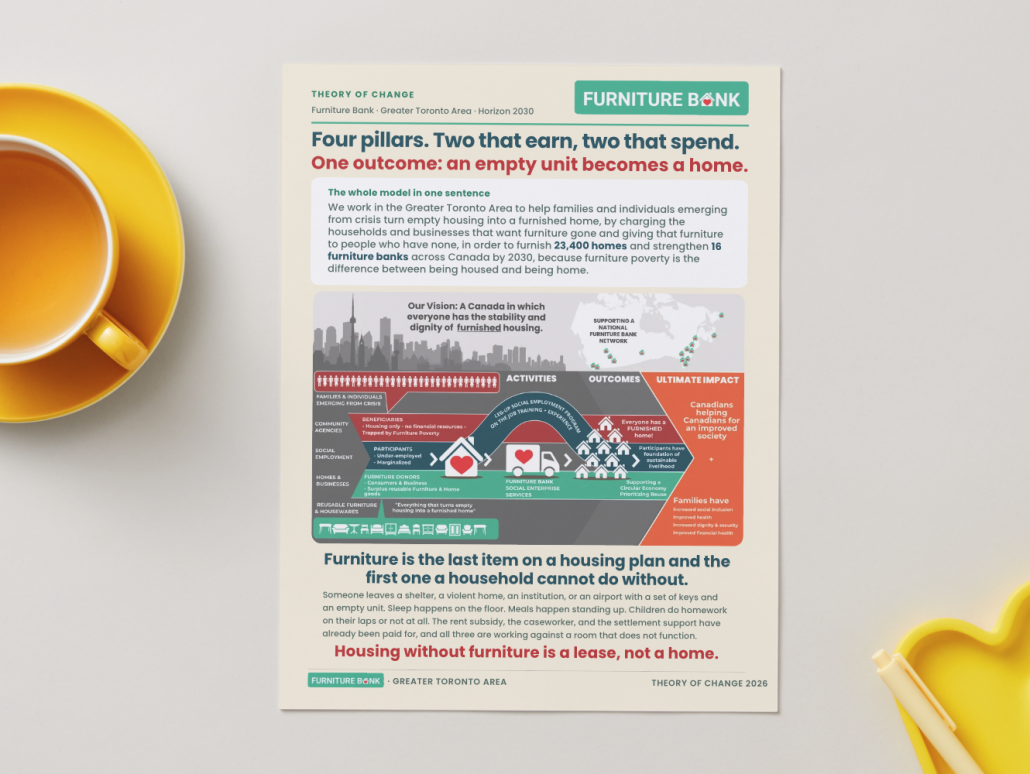
- A funder asked for your theory of change — the one-sentence version you can write this week, with our three-page funder brochure to download and copy
- How do you prove your diversion numbers are real? — weighing proves tonnage, not diversion. One survey question closes the gap; 415 donors answered it in Toronto
- Which SDGs should a furniture bank claim? — four of seventeen, mapped to target and indicator level rather than displayed as icons
- Is a forecast SROI good enough for my funder? — usually yes, if you label it. Includes the four-line disclosure sentence to paste beside your number
- Can I compare my SROI to another furniture bank’s? — what the ratio is for, and what to compare against a peer instead
- What does it take to build a full impact measurement system? — three years, an outside consultant, and a weekly discipline. The honest cost before you commit
Using it well
Two rules make the difference between a number a funder defends internally and one they quietly stop citing.
Label a forecast as a forecast. This tool applies Toronto’s measured outcomes to your counts; nobody surveyed your clients. Say that in the same sentence as the number and most funders will take it.
Use the ratio against yourself, not against a peer. Because every organisation’s cost base sits in the denominator, ratios track budget structure as much as performance. Tracked year over year with the same method, the ratio is a genuine management signal — which is why Furniture Bank has published its own series since 2017, including the years it fell. Against a peer, compare households furnished, items delivered, tonnes diverted and volunteer hours.
The reason all of this is free is that shared definitions only work if everyone can reach the tools. Every furniture bank gets the same funder question. Answering it in one shared language is worth more to the sector than any one of us answering it well alone.
Get the Toolkit and get support
Download the Impact Measurement Toolkit (PDF, 60 pages) →
Training on the estimator, help interpreting your results, or coaching on data collection comes through Furniture Banking Support Services. Get in touch and we will point you at the right starting place for your stage.
Suggested citation: Furniture Bank Toronto. (2025). Impact Measurement Toolkit for Furniture Banks.