TLDR. You have three routes for an item you cannot place: repair it, recycle it, or refuse it at the door. Most banks default to refusing, which is the cheapest and the one that costs you the most donors. A repair workshop is the expensive option and it pays back in two currencies at once — one bank has put 18,606 items through theirs since 2015 and trained more than 31 people in the process. Decide your standard first, then build the route.
The decision you are actually making
A donor calls about a dining set. One chair has a cracked leg. Do you take it?
Say yes and you own the repair, or the disposal. Say no and you have told somebody their furniture is rubbish, and you may not hear from them again — or from whoever they tell. That is the whole problem in one phone call, and it repeats a few hundred times a month.
The useful frame is not “what do we accept” but “what routes out do we have.” Accept-or-refuse is a binary only because most banks have built only one route.
Route one: set the standard and hold it
The most widely used rule across the Network is a version of this: if you would not let your mother sleep on it, do not accept it. It works because it is a dignity test rather than a condition checklist, and a volunteer can apply it without a manual.
Holding the line matters more than where you draw it. A bank that accepts everything ends up running a waste transfer station with a charitable registration, and the cost shows up as tipping fees and staff time rather than as a line called “items we should have refused.”
The corollary is that your refusal has to be teachable. “We can’t take that” is a dead end. “We can’t take that because of the tear in the seat cushion, but the bookcase and the lamps we’d take today” keeps the donor.
Route two: repair, if you can carry it
A repair workshop converts items you would have refused into items you can place, and converts staff hours into a training program at the same time.
Furniture Bank in Toronto has run one since 2015. Over that period it has repaired or salvaged 18,606 items and trained more than 31 individuals through it. Those two numbers are the honest picture of the model: the throughput is meaningful but it is not the main event, and the headcount trained is small because a workshop is a place where a few people learn a trade properly rather than where many people pass through.
What makes it work is that the same activity serves two goals. The items are inventory you would otherwise not have. The workshop is a supervised setting for people facing employment barriers to build a demonstrable skill. Fund it as one thing and you will struggle; fund it as inventory recovery and a training program and the case is much stronger.
What it costs: space, a supervisor who can actually teach, tools, consumables, and the discipline to stop working on an item when the labour exceeds its replacement value. That last one is where workshops quietly bleed. Set a time box per item and enforce it.
Route three: recycle, and know your route before you need it
Some items are neither placeable nor repairable. The question is whether they leave your building as a disposal cost or as a diverted tonne.
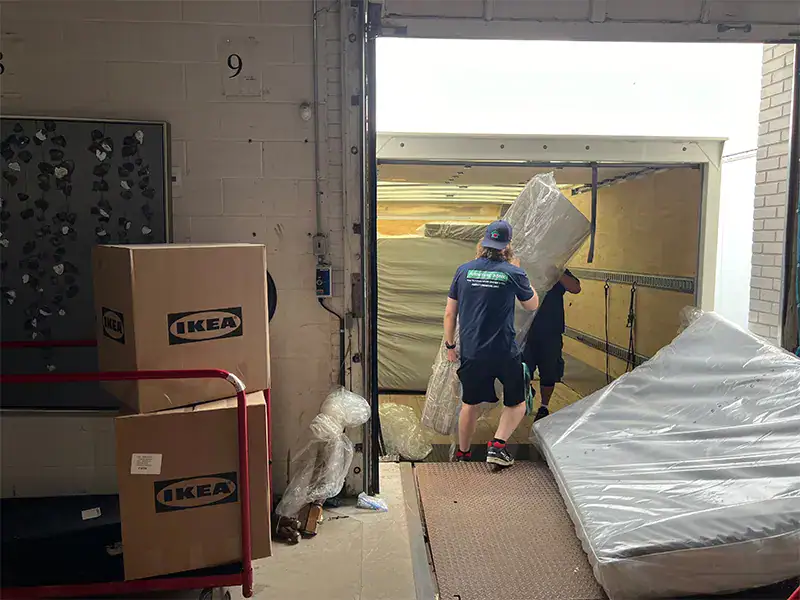
Several Network members route what they cannot place to a local mattress or furniture recycler, and some charge donors a disposal fee on items accepted below standard. Both are legitimate. What is not survivable is discovering you have no route on the day a 53-foot trailer arrives — see how a retailer return partnership actually works for what happens when volume arrives faster than your outbound capacity.
Find your recycler before you need one. Ask what they take, what they charge, what condition they require, and whether they will issue you a weight receipt — because that receipt is what turns disposal into a diversion number you can report.
Why the routing is also a reporting decision
Diverted tonnage is one of the few numbers that speaks to municipal funders, corporate partners and environmental reporting all at once. Toronto diverted 47,419 pieces and 919 tonnes in 2023, with 2,214 tonnes of carbon abated against it.
An item you refuse at the door counts for nothing, whatever happens to it afterwards. An item you accept and route to a recycler counts, provided you weighed it. That is not a reason to accept everything — it is a reason to make sure the items you do accept are being counted on their way out as carefully as on their way in.
Common pitfalls
- An unbounded workshop. Without a per-item time limit, your most skilled person spends three hours on a chair worth forty dollars.
- Refusing without explaining. The donor hears a judgement about their home, not a standard about your inventory.
- No weight receipts. Tonnage you cannot evidence is tonnage you cannot claim.
- Accepting to be kind. Every item accepted below standard is either a disposal cost or something a client is offered and declines. Neither is kindness.