TLDR. Budget three years, not three months. Furniture Bank in Toronto started auditing its own measurement in 2022, began implementing in 2024, and published a verified social return figure of $6.49 per dollar for that year. The sequence matters more than the software, and the first two steps cost you nothing but argument time. If a funder is asking you for a number right now, start counting six things and say plainly that the ratio is coming.
The question behind the question
A funder asks for your social return on investment. You do not have one. The honest problem is not that you cannot calculate a ratio — a consultant will produce one in a few months if you pay them. The problem is that a ratio built on data you do not routinely collect is a number you cannot defend, repeat next year, or use to run your organisation.
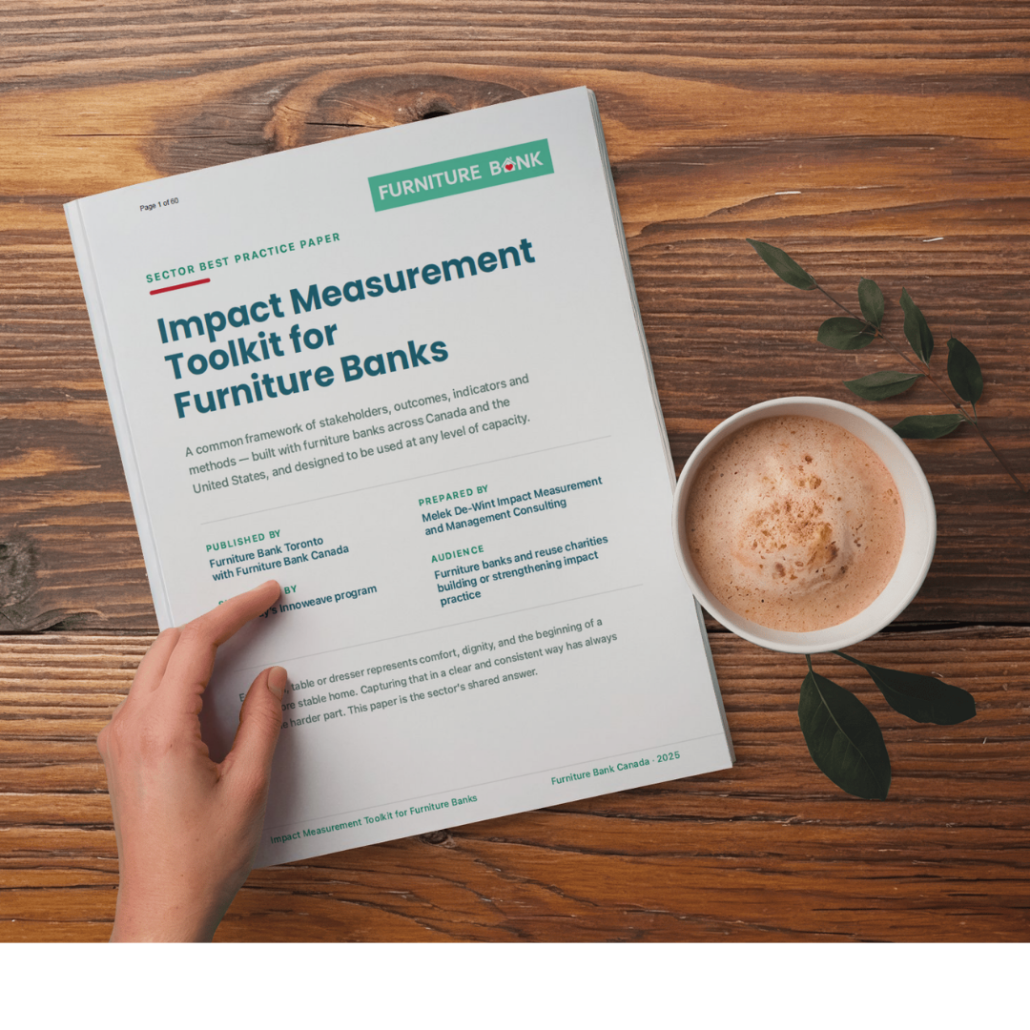
So the real question is what it takes to build the underlying system. Furniture Bank in Toronto has published its working in unusual detail, which makes it a useful reference point for anyone earlier in the process. What follows is drawn from their 2025 impact framework and their account of the journey that produced it, reframed for an operator deciding whether to start.
The timeline, stated honestly
2022: an audit of what was already being measured, which surfaced the gaps. 2023: an improvement roadmap. 2024: implementation, and the first year measured end to end under the new framework. 2025: publication, with an external impact measurement consultant involved throughout.
Three years from first audit to a number anyone would put in a funding application. Anybody selling you a faster route is selling you a ratio, not a system.
The sequence that produced it
Six steps, in this order. The order is the part worth stealing.
- Stakeholder mapping. Everyone your work touches, not just clients. Toronto’s list runs to clients, referral agencies, furniture donors, corporate partners, staff, volunteers and the environment. If you skip this you will measure clients only and undercount your own value by more than half.
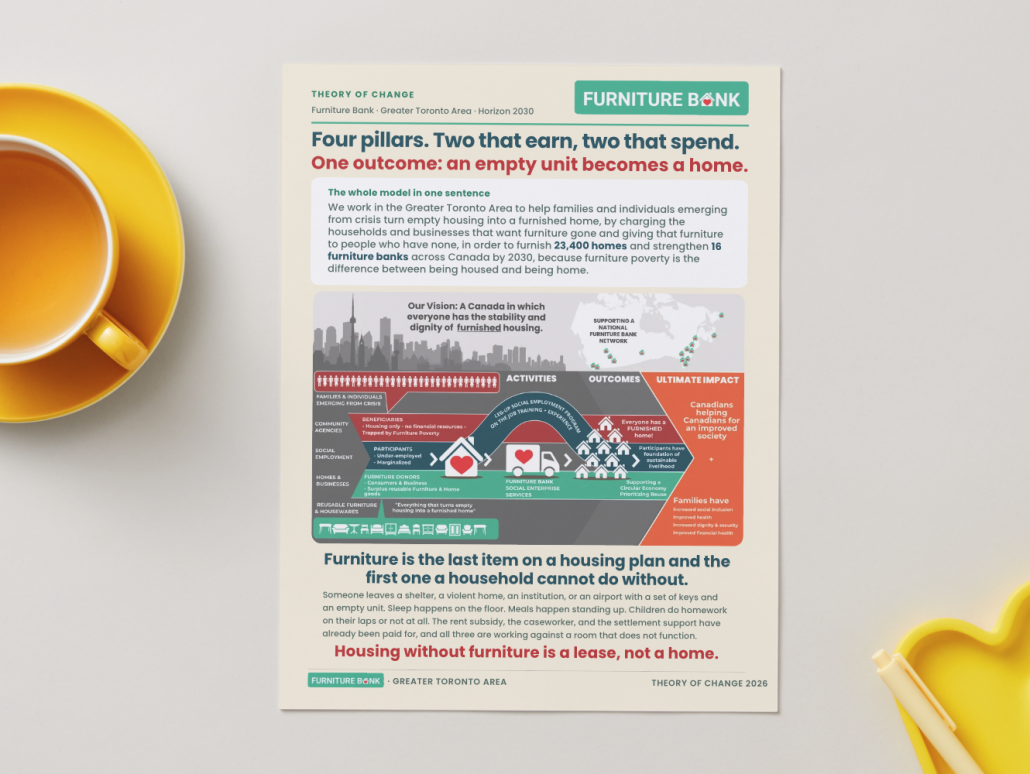
- Pillar identification. Group your activities into coherent impact areas. Toronto landed on four: Homing, Social Employment, Sustainable Consumption, and Network Development. Yours may be two. The point is that a pillar is the unit a funder can understand and you can report against.
- SDG mapping. Align each pillar to the UN Sustainable Development Goals at target and indicator level. Toronto maps to SDG 1, 8, 11 and 12. This is not decoration — it gives you shared language with government and corporate funders who already report this way.
- Theory of Change. Write down how your activities are supposed to produce outcomes. This is the step most organisations skip and the one that makes the rest coherent.
- Program-level measurement. Instrument each program separately before you try to total anything.
- The framework. Only now do you assemble the whole thing, and only now does an SROI ratio mean something.
Steps one and two cost nothing but staff time and some uncomfortable internal argument. You can do them this quarter.
What the data collection actually looks like
The methods are less exotic than the framework language suggests:
- Surveys run on an ongoing and periodic basis, built in Typeform
- 90-day client follow-ups — the single hardest discipline to hold, and the one that produces outcome data rather than output data
- Focus group interviews with referral agencies
- Automated transfer between collection tools and the analysis platform, so nobody is retyping anything
- Descriptive statistical analysis rather than anything inferential
The 90-day follow-up is where most attempts die. It requires someone whose job it is, every week, and it requires asking people who have moved on from a crisis to think about it again. Toronto designs the questions to capture outcomes without being intrusive and offers multiple response methods. Budget for a person, not a tool.
What the numbers looked like
Toronto’s 2024 results, as published:
- $6.49 of social value created per $1 invested
- 59% of that value attributed to clients, the balance split between furniture donors and referral agencies
- Among referral agencies: 85% said the partnership contributed to increased housing stability for their clients, 74% that it enhanced their capacity to support client needs, 66% that it reduced the time and resources they spent procuring furniture
- Among furniture donors: 89% felt they were giving back to others, 37% to the planet, and 18% said they would have thrown the item away otherwise
- Client outcomes clustered into five themes: quality of life, mental health, physical health, social inclusion, and sense of belonging. The single most commonly reported outcome was “I worry less about money”
- 953 tonnes of furniture diverted from landfill
The agency numbers are the ones worth copying. They are cheap to collect, they speak directly to a funder’s theory of why you matter, and they are about organisations rather than individuals, so no client has to expose anything to produce them.
What it costs you
Three years of elapsed time. An external consultant for the framework and the SROI methodology. Staff time for the 90-day follow-ups, permanently, not as a project. A survey tool and eventually an impact management platform — Toronto is moving to Clear Impact and building public-facing dashboards. And the organisational discipline to keep collecting when nobody is currently asking for the data.
That last one is the real cost. The framework is not the hard part.
Three things to know before you quote your ratio
A system this size produces a single headline number, and that number is more fragile than it looks.
- Your ratio is not comparable to anyone else’s. Five teams handed one identical case study produced ratios from $1.16 to $6.60. Here is why, and what to compare instead.
- A forecast SROI is legitimate if you label it. Most funders will accept one. The difference between forecast and evaluative, in one paragraph each.
- You do not need any of this to start. Six counts, one twelve-month period, same definitions every year. Start here instead.
Where to start this month
Map your stakeholders and name your pillars. Both are meetings, not projects. Then pick the six counts and hold the definitions steady for a full year. When a funder asks for a ratio before you have one, tell them what you count, how long you have been counting it, and when the ratio will exist. In our experience funders respond better to that than to a number with no system behind it.
Source material: Furniture Bank Toronto’s New Approach to Impact Measurement and Impact Measurement Journey. All figures are Furniture Bank Toronto’s own, for 2024 unless stated.